


.svg)
-

IoT Knowledge Base
Learn the key concepts you need to know. Without the technical jargon.
-

IoT Reports & Guides
In-depth research, white-papers and guides from Pelion.
-

Blog Articles & News
The latest insights on industry trends, best practices, and Pelion announcements.
-

Events & Webinars
Upcoming events, online sessions, and expert-led webinars


-

About Us
Our mission, values, team, and the solutions we offer in the IoT space.
-

The Team
Meet our team behind Pelion's effortless connectivity.
-

Careers
Job opportunities, company culture, and the benefits of joining our team.
-

Sustainability
Our commitment to environmentally responsible practices.
-
Contact Support
-
 Contact Us


- Blog Articles & News
- 10 Best IoT eSIM Providers for Every Deployment Case in 2026
- The 10 Leading IoT eSIM Providers: Key Features, Pricing, Integration Breakdown, Pros, and Cons
- Quick Summary
- What Should Businesses Know About IoT eSIM in 2026?
- Why Trust Us?
- Selection Criteria: How We Chose the Best 10 IoT eSIM Providers
- The 10 Leading IoT Providers in 2026 Reviewed
- 1. Pelion
- 2. Wireless Logic
- 3. Hologram
- 4. emnify
- 5. Soracom
- 6. CSL Group
- 7. KORE Wireless
- 8. 1NCE
- 9. Eseye
- 10. Onomondo
- How to choose an IoT eSIM provider for your specific IoT ecosystem
- Choose a reputable IoT eSIM provider with guaranteed uptime
- Frequently Asked Questions
10 Best IoT eSIM Providers for Every Deployment Case in 2026
April 22, 2026 — 19 min read

The 10 Leading IoT eSIM Providers: Key Features, Pricing, Integration Breakdown, Pros, and Cons
Quick Summary
When it comes to IoT eSIM providers, Pelion ranks the highest for scalable, cross-border IoT deployments, followed by Wireless Logic and Hologram. While many eSIM providers handle basic connectivity, differences in reliability, pricing, and support become critical at scale. Enterprise use cases require more than just coverage. As always, the right choice depends on how far your deployment has progressed.
What Should Businesses Know About IoT eSIM in 2026?
Most businesses start with a consumer SIM or a single-network provider that works well for a proof of concept. Once deployments move into production, expand across borders, or scale to hundreds of devices, the limitations start to surface. You begin to see inconsistent coverage, rising costs, and limited support when issues occur.
Meanwhile, providers that look similar on a coverage map often operate differently in practice. Differences in reliability, pricing models, and operational support only become clear when deployments scale.
An IoT eSIM is a remotely programmable embedded SIM designed for machine-to-machine (M2M) communication. Unlike consumer SIMs, it stores and switches multiple carrier profiles over-the-air (OTA), which enables sensors, trackers, and smart meters to maintain reliable, multi-network global connectivity without physical SIM replacement.
This guide breaks down how leading IoT eSIM providers compare across these areas, helping you identify which solution fits your deployment stage, technical requirements, and long-term operational needs.
Why Trust Us?

 Originally called Stream Technologies, Pelion has been connecting IoT deployments since 2000. With over 25 years of hands-on experience and 1,000+ enterprise customers across industries such as IIoT, Healthcare, Energy & Utilities, Fleet Management, and more. Pelion understands what businesses need from a connectivity partner at every stage of an IoT project.
Selection Criteria: How We Chose the Best 10 IoT eSIM Providers
After reviewing leading IoT eSIM providers through vendor documentation, technical specifications, and real-world deployment considerations, we shortlisted the ten best ones based on the following criteria:
1. Network resilience and coverage model: We assessed not just how many networks each provider claims, but how connectivity is delivered. This includes whether providers rely on roaming agreements or offer true multi-network access with the ability to switch profiles dynamically across regions.
2. eUICC maturity and standards support: We evaluated support for GSMA standards such as SGP.02, SGP.22, and SGP.32, which determine how easily SIM profiles can be provisioned, updated, and managed remotely at scale.
3. Connectivity management and lifecycle control: We looked at how effectively each platform supports SIM lifecycle management beyond activation, including real-time monitoring, usage control, automation via APIs, and the ability to manage deployments across multiple regions.
4. Operational support and deployment readiness: We assessed whether providers offer structured support models, including SLAs, escalation paths, and pre-deployment testing. This becomes critical for deployments where connectivity directly impacts operations.
5. Commercial model and cost predictability: We compared pricing structures such as pooled data, pay-as-you-go, and fixed models, focusing on how well each approach scales with growing deployments and varying data usage patterns.
6. Security and network architecture: Finally, we reviewed each provider’s approach to secure connectivity, including private APNs, VPN support, access controls, and how data is routed across networks to meet compliance and security requirements.
The 10 Leading IoT Providers in 2026 Reviewed
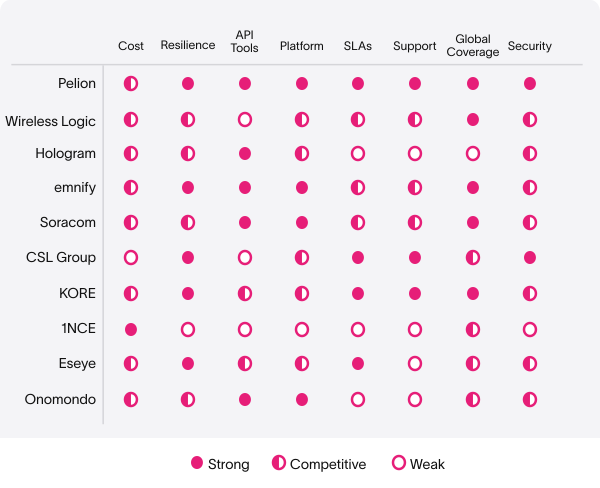
1. Pelion

Pelion delivers multi-network IoT SIMs with a fully managed service. The Pelion Portal offers both digital and physical eUICC-enabled eSIM formats with full over-the-air (OTA) profile switching and support for SGP.02, SGP.22, and SGP.32, with architecture designed to support next-generation provisioning as they reach commercial availability.
Pelion maintains 99.995% uptime, a level of availability that is ahead of much of the market. While the difference between 99.995% and 99.99% may appear marginal on paper, in practice it represents a significant reduction in service disruption over the course of a year. For deployments where connectivity loss directly impacts operations, uptime resilience at this level becomes a critical operational consideration, and Pelion’s architecture and service model are designed accordingly.
Key Features
Multi-Network IoT SIMs: Access to 600+ networks across 150+ countries with 99.995% uptime and reliability.
Global Connectivity via a Single SIM: Support for 5G, 4G/LTE, CAT-M1/LTE-M, NB-IoT, CAT-1 BIS, with physical and eUICC-enabled eSIM formats with OTA switching.
Connectivity Management Platform: Pelion Portal, SIM lifecycle management, usage monitoring, cost controls, invoice management, OTA updates, VPN (Dual IPSec on Professional and Enterprise), and Private APN.
Managed Service & IoT Expertise: Pre-operation testing and strategy support, 24/7 global support, deployment strategy support from experienced IoT specialists, and flexible IoT security support for endpoints and wider attack surfaces.
Pricing & Pelion Plans
Pelion Plans are designed to give organisations flexibility in how they deploy and scale IoT connectivity, with transparent pricing and service levels that align to different operational needs. Rather than forcing customers into a one-size-fits-all model, Pelion provides clearly defined plans that allow businesses to select the right balance of connectivity, support, security, and operational management for their deployment.
A key part of this approach is transparency. Pelion’s pricing calculator allows customers to model costs upfront, helping teams understand exactly what their deployment will require before committing. Whether supporting a small regional rollout or a globally distributed, mission-critical estate, customers can identify the plan and commercial structure that best fits their operational and financial requirements.
Pelion Essentials provides the foundation for secure IoT connectivity, including regional and global network access, use of the Pelion Portal, and essential support capabilities. For organisations requiring greater operational resilience and security,
Pelion Professional introduces features such as Dual IPSec VPN, enhanced incident response, and guidance for eUICC migrations.
At the highest tier, Pelion Enterprise delivers a fully managed experience with a dedicated account manager, advanced monitoring, quarterly service reviews, and white-glove support for large-scale or business-critical deployments.
This tiered approach ensures organisations can adopt an IoT bundle that reflects the complexity, scale, and criticality of their deployment - with the flexibility to evolve as requirements grow over time.
Integration breakdown
Pelion does not presuppose any specific internal tech stack. The API is designed to connect to whatever systems you already use. Private APN and VPN options provide secure, dedicated connectivity paths for deployments with data sovereignty or compliance requirements. Pre-deployment testing also helps teams validate device and network compatibility before committing to a production rollout.
Pros
99.995% uptime per year
25+ years of IoT-specific expertise
Pooled data plans deliver real cost advantages
24/7 support from IoT specialists
Multi-network IoT SIMs that work across borders
Cons
More focused on long-term deployment and operations than lightweight, self-serve use cases
2. Wireless Logic
Wireless Logic services users across 165 countries, with access to 700+ networks through its Conexa IoT network. It is well-suited to large, multi-national enterprises with complex procurement processes and long deployment timelines.
That said, the company’s acquisition-led growth has resulted in multiple platforms and operating models, creating inconsistencies in customer experience and integration complexity. For teams that prioritise a more unified platform and simpler operational model, alternative providers like Pelion may offer a more streamlined approach.
Key features
Conexa IoT network: Get access to 750+ networks in 190 countries.
SIMPro: Dedicated portal for lifecycle management.
Full form factor support: This includes physical SIM, iSIM, eSIM chip, and virtual profile.
Pricing
All Wireless Logic plans are negotiated based on deployment size, geography, and support requirements. Commercial terms are typically subscription-based, with volume pricing available for large enterprise programmes.
Integration breakdown
Wireless Logic integrates via REST API. It also supports connections to third-party device management platforms, ERP systems, and operational tools. Local breakout options across key markets ensure data routing compliance for businesses with sovereignty requirements.
Pros
Industry-leading network depth across 190 countries
Infrastructure built with forward compatibility for next-generation GSMA provisioning standards
Comprehensive security framework
Cons
Smaller teams may find better pricing and account management elsewhere
Support experience can vary at lower volumes
Less pricing transparency for businesses that want to self-serve and compare quickly
3. Hologram
Hologram is a US-centric IoT connectivity provider that augments developer-led teams and early-stage deployments where speed and API access matter most. However, as deployments scale across regions, its per-MB pricing model can become harder to predict compared to pooled data approaches. For teams moving into production at scale, this is where providers like Pelion offer more cost control and operational support.
Key features
Dual-Core Redundancy: Built-in failover architecture for continuous uptime.
OTA Profile Switching: Remote carrier profile updates over the air.
High-Speed Connectivity: Data rates up to 300 Mbps with latency as low as 50 ms.
Pricing
Flexible data plans are available for higher-volume deployments, and enterprise pricing is negotiated for larger fleets. A free pilot SIM is available for you to test before committing to a plan.
Integration breakdown
Hologram connects via REST API and supports private APN for secure, isolated data routing. The platform integrates with AWS IoT, Azure IoT Hub, and other cloud services. Also, the webhook-based event triggers can push SIM activity into external systems.
Pros
Transparent per-MB pricing
Good developer experience
Dual-core redundancy for uptime protection
Cons
Support can be slower to scale at peak periods
Primarily US-oriented
Less structured enterprise account management compared to specialist providers
4. emnify
emnify’s Bootstrap Connectivity model allows devices using a single global IoT SIM to connect immediately at the factory, regardless of deployment region. This makes it well suited to manufacturers looking to simplify provisioning and streamline early-stage deployment.
However, once devices move from provisioning into live operation, the requirements change. The focus shifts to ongoing lifecycle management, monitoring, and support. In these scenarios, emnify places less emphasis on dedicated managed services and operational support, which can become a limitation for teams running large or globally distributed deployments.
Key features
Single Global eSIM SKU: One eSIM product for worldwide IoT deployments.
Third-Party Operator Profiles: Support for external carrier profile integration.
Chip-Level Fallback Profiles: Embedded backup connectivity at the hardware level.
Pricing
emnify’s pricing is structured around deployment volume, chosen network coverage, and platform features.
Integration breakdown
emnify integrates with AWS IoT, Azure IoT Hub, and Google Cloud IoT through native connectors, and the REST APIs cover device provisioning, usage monitoring, and policy management. The platform also supports integration with ERP and supply chain systems for manufacturers who want to align SIM provisioning with production workflows.
Pros
Factory-first architecture reduces complexities
eUICC architecture built for compatibility with emerging zero-touch provisioning standards
Single eSIM deployment
Cons
Offer less focus on long-term managed service and deployment support
Enterprise onboarding process may not suit smaller-scale or faster-moving deployments
Less established in the UK market compared to providers with a stronger domestic presence
5. Soracom
Soracom is effectively a cloud-native IoT platform that includes connectivity. Its AWS-centric architecture is a strength for teams already embedded in that ecosystem and a friction for everyone else. That said, if your business is looking for a standard multi-network connectivity without anchoring its architecture to a single cloud provider, you might want to consider other competitors.
Key features
Full MVNO Platform: Cloud-native connectivity with end-to-end network control.
Connectivity Hypervisor: Multi-profile orchestration for dynamic carrier management.
Soracom Query: Natural-language analytics for fleet data insights.
Pricing
Base data rates start at around $0.017 per MB, depending on the region, with volume discounts available.
Integration breakdown
Soracom integrates natively with AWS IoT Core, Lambda, S3, and other AWS services. REST APIs cover device management, traffic rules, and usage data. The platform also supports integration with third-party device management systems and cloud providers beyond AWS.
Pros
Strong AWS-native integration
Connectivity Hypervisor with multi-profile orchestration and forward-compatible provisioning infrastructure
Satellite NTN option extends coverage for remote deployments
Cons
Complex onboarding compared to pure connectivity providers
AWS-centric architecture may not suit teams on Azure or GCP
Less emphasis on dedicated managed services or specialist IoT support
6. CSL Group
CSL helps you connect multiple devices through CSL across healthcare, security, fire safety, utilities, transport, and infrastructure. The rSIM uses a multi-IMSI architecture with dual-anchor cores and a proprietary roaming algorithm that prioritizes connection strength over network steering.
However, a business running fleet tracking, smart metering, or EV charge points might not enjoy the core value of CSL’s rSIM's dual-path signalling or the ARC integrations.
Key features
rSIM Technology: Patented multi-IMSI SIM with a proprietary roaming algorithm.
Dual-Core Resilience: Redundant architecture with dual-path signaling.
Unsteered Roaming: Automatic access to the strongest available network.
Pricing
CSL prices are on a per-deployment basis, depending on the use case.
Integration breakdown
CSL integrates with Alarm Receiving Centres and monitoring platforms for security and telecare use cases. It also provides Private APN and VPN options with dedicated, secure connectivity paths.
Pros
Multi-IMSI architecture
Patented rSIM architecture
ARC integration
Cons
Relatively weak enterprise IoT outside healthcare, security, or utilities
No pricing self-service options
Less geographic breadth than high-end competitors
7. KORE Wireless
Kore Wireless is a publicly traded IoT connectivity provider. Its OmniSIM is a multi-IMSI eUICC eSIM with access to 500+ networks in 200+ countries, making it a strong fit for enterprises that want a single partner across deployment, connectivity, and ongoing operations. The Super SIM platform adds developer-grade API control, automatic failover, and per-SIM/per-network pricing.
However, the company’s services-heavy approach can introduce additional complexity compared to more product-led platforms. For teams that prioritise faster deployment, flexibility, or a more streamlined user experience, this can become a consideration.
Key features
Hybrid Satellite & Direct-to-Cell: Integrated terrestrial and satellite connectivity.
Connected Health Solutions: Purpose-built devices for healthcare telemetry.
AI-Driven Network Recovery: Intelligent restoration of disrupted connections.
Pricing
Kore offers both pay-as-you-go and subscription-based pricing. You can negotiate the rates based on SIM volume, target markets, and required connectivity standards. A free IoT SIM starter kit is also available for initial evaluation.
Integration breakdown
Kore integrates with AWS IoT, Azure IoT Hub, and Google Cloud IoT through published APIs. The platform also connects with device management systems and operational platforms used in healthcare, fleet, and utilities verticals.
Pros
Good pricing and support systems
Local compliance profiles for North American regulated markets
Satellite connectivity option for deployments in remote locations
Cons
Shallow domestic network depth for UK and EU users
Platform complexity may not suit smaller deployment needs
Less established in the UK market compared to other providers
8. 1NCE
1NCE is designed for cost-sensitive deployments with low and predictable data usage, using a simple prepaid model. This makes it a strong fit for static use cases where connectivity requirements remain minimal over time.
However, the limitations of fixed data allowances and a lighter support model become more apparent as data usage increases or deployments become business-critical. This can create challenges for teams that need flexibility, ongoing support, or consistent performance at scale.
Key features
OpenVPN Support: Secure remote connectivity via VPN tunneling.
1NCE OS Integration: Device management through AWS cloud services.
REST API: Programmatic access for automation and system integration.
Pricing
The Lifetime Flat tier ranges from $14/SIM, and the Industrial eSIM chip ranges from $2.50. High Data IoT plans are available for higher-bandwidth needs.
Integration breakdown
1nce OS is built on AWS IoT Core, providing native integration with the AWS ecosystem. The REST APIs cover device management, usage data, and account controls. Ince’s OpenVPN support enables secure private connectivity for deployments with data security requirements.
Pros
Predictable pricing model
Deutsche Telekom backing
Suitable for large-scale sensor networks with variable activity
Cons
500MB cap over 10 years limits use to low-bandwidth applications
Not suited for high-frequency telemetry, video, or real-time data streaming
Limited enterprise-grade support and account management at volume
9. Eseye
Eseye offers a connectivity platform designed for complex enterprise deployments, with multi-profile eSIM capability and advanced tooling for device management and provisioning. Its Infinity platform provides centralised visibility and control across large device fleets, making it well-suited to organisations with complex requirements.
That depth typically requires a more involved implementation. Teams should expect longer rollout timelines and a higher dependency on professional services, particularly when scaling across regions. This makes it a stronger fit for organisations with the resources to support complex deployments, rather than teams prioritising speed and repeatability.
Key features
Multi-Bootstrap SIM Profiles: Up to 10 preloaded profiles per SIM for resilient provisioning.
Infinity IoT Platform: AI- and ML-powered analytics for device intelligence.
Integra Platform: White-label IoT connectivity solution for mobile operators.
Pricing
Eseye charges based on usage connectivity, with the overall commercial model tailored towards enterprise deployment scale.
Integration breakdown
The Infinity Platform provides API-driven integration with device management systems, cloud environments, and operational platforms. Eseye also supports third-party operator profile management alongside its own connectivity, giving enterprises flexibility to consolidate carriers under one management layer.
Pros
Near-100% uptime through autonomous intelligent network switching
AI-driven platform with predictive anomaly detection
10 preloaded profiles with each SIM
Cons
Unsuitable for early-stage deployment needs
Platform depth comes with a steep learning curve
Less emphasis on hands-on managed service than specialist providers
10. Onomondo
Onomondo takes a cloud-native approach to connectivity, giving teams direct control over network selection and detailed visibility into device-level traffic. This makes it well-suited to engineering teams that prioritise transparency and want to manage connectivity through APIs rather than managed services.
As deployments grow in size and operational complexity, the need for structured support and defined service models becomes more important, though. Onomondo places less emphasis on dedicated managed services, which can create gaps for organisations running large, business-critical fleets.
Key features
Cloud-Native Core: Direct integration with RAN for streamlined connectivity.
Single Global Profile & APN: One profile for worldwide IoT deployments.
Non-Steered Network Selection: Automatic access to the strongest available network.
Pricing
Onomondo operates a pay-as-you-go model, meaning you only pay for SIMs that have actually transmitted data in a given billing cycle. A free trial and a month-to-month sandbox subscription are available for teams at the testing stage.
Integration breakdown
Onomondo's API-first platform integrates with existing device management pipelines, cloud platforms, and custom dashboards. Webhook support makes it straightforward to push SIM events, including activations, data thresholds, and network switches, into external systems.
Pros
In-class network transparency
Billing reflects actual usage
SoftSIM enables hardware designs without a physical SIM component
Cons
Less focus on enterprise-scale managed service
Smaller network footprint compared to providers
Shallow support depth for providers with dedicated IoT specialists
How to choose an IoT eSIM provider for your specific IoT ecosystem
The right provider depends on your deployment geography, your device profile, and your team's technical approach. Here's how to approach the evaluation process:
1. Know your geography first
If your devices operate in the UK, you don’t need a 190-country coverage map, as that is thin on local performance. You need deep domestic network access and reliability. So, ask specifically how each provider handles regulatory restrictions in your target regions.
2. Match the pricing model to your data profile
Pooled data plans reduce per-SIM costs across large fleets with varying usage patterns. Pay-as-you-go billing suits unpredictable or early-stage deployments.
3. Evaluate support as a product
When your devices go offline at 2 am, the quality of support you can access determines how quickly you recover. Ask specifically what the escalation path looks like. Also, ask about SLA response times for incidents versus general queries.
4. Assess the management platform
Demo the portal with a real scenario from your deployment. Can you bulk-activate, set usage thresholds, suspend compromised devices remotely, access API documentation, and run a test call? All these matter more than the coverage headline.
5. Test in your actual deployment environment
Most providers offer trial kits or sandbox plans. Use them in the locations and with the hardware you'll actually deploy. Coverage maps and real-world connectivity can differ significantly, and discovering the gap after a production rollout is an expensive lesson.
Choose a reputable IoT eSIM provider with guaranteed uptime
Most providers on this list can connect your devices. The differences show up when you scale across multiple countries, manage large SIM volumes, or need reliable support.
Pelion's 25+-year track record, 99.995% uptime, pooled data pricing, and 24/7 expert support make it a strong fit for UK-based businesses and cross-border global deployments. If you're deploying 50 or more SIMs and need a partner rather than just an eSIM provider, Pelion can help you. View the Pelion Pricing Calculator or talk to our team today to discuss your specific IoT deployment requirements.
Frequently Asked Questions
1. What GSMA standards do current IoT eSIMS use?
The current IoT eSIMs operate primarily on SGP.02 and SGP.22 standards. SGP.02 enables remote SIM provisioning through a standardised M2M architecture, while SGP.22 introduced a more flexible consumer-grade profile management model.
2. What is the upcoming SGP.32 IoT SIM standard, and how is it expected to change IoT connectivity?
SGP.32 is the next-generation GSMA standard for IoT eSIM provisioning. Unlike SGP.02, which relies on SMS-based provisioning, SGP.32 introduces IP-based protocols designed to enable zero-touch remote provisioning at scale. It has not yet launched commercially and is expected later in 2026. When evaluating providers, ask about their roadmap for SGP.32 readiness rather than current support.
3. How many SIMs do I need before multi-network connectivity makes commercial sense?
Most enterprise providers are built for deployments of 50+ SIMs, with pricing advantages becoming more significant at 500+. That said, the operational benefits of multi-network connectivity apply at any scale. Even smaller deployments benefit from not being tied to a single network's coverage and reliability.
4. What is the difference between multi-network and single-network IoT SIMs?
A single-network SIM is locked to one carrier. If that carrier has an outage, a coverage gap, or changes its roaming policies, your devices go offline. A multi-network SIM can switch between carriers automatically. The switch can occur either through the SIM's own intelligence or through a management platform. This switch gives your deployment resilience against any single point of failure.